
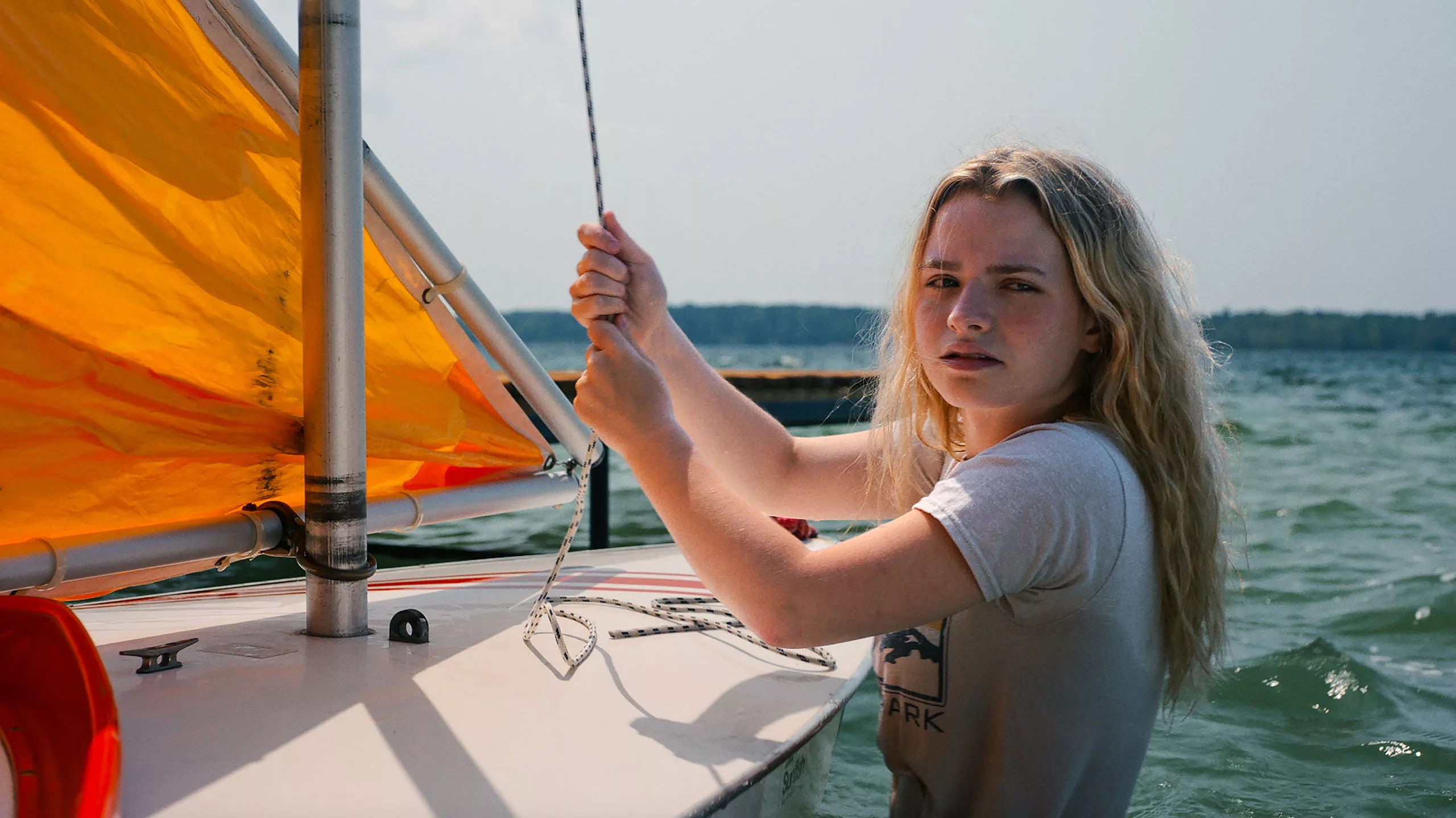
Writer-director Sierra Falconer has reached back into her childhood memories of summers at her old Michigan lake home and managed to spawn a delicate and vivid capsulation of simplicity and romanticism on the water. For those that love soaking in the summer air of lake home life, Sunfish (and Other Stories on Green Lake) works as a brief, but rewarding little escape. “The summer that changed everything” has become a decades-long trope in cinema with films centered on youth, but Falconer never leans into that, allowing her young characters to just merely exist, struggle with their emotions, each striving to be more accomplished in some capacity with their lives, but also just let life happen as it happens. Thematically, most of the stories are linked in that way, though Falconer’s naturalism brings a borderline documentarian approach, as though we are just peering into a random day in the life of these young, ambitious kids.
The movie begins on the story of a young girl named Lu, who is forced to stay at her grandparents’ cabin for an unforeseeable amount of time due to her negligent mother deciding to run off and marry her current boyfriend. Complicated emotions arise and Lu, who can’t help but feel alone despite her grandparents’ newfound involvement in her life. She takes her frustrations on learning to prepare and steer a sail boat, the titular Sunfish. Through the guidance of her grandfather, eventually she learns how to properly set sail. That is the extent of the plot of the first story and a good idea of what to expect with the next batch of tales. Falconer is not interested in drama whatsoever, she instead strives to capture an intimate vibe, one that places us directly inside the eyes of our characters as they channel inner peace with the nature that surrounds them.
The second story transitions to a summer band camp, where a young boy named Jun, pressured by his mother to succeed in violin, practices his fingers to the bone to audition for first chair in violin. What begins as an artist’s simple process into musicality, turns nearly into Whiplash (2014) as he is borderline harming himself to get his insanely complicated music assignment down pat. Striving for perfection, he is eventually able to see that it is okay to let your guard down around others, even around classmates who what that chair seat as bad as he does.
The third story involves a bartender joining a fisherman on a quest to find and locate the mythical large catfish of Green Lake. The one adult-centered story, what starts as a unique concept eventually begins to feel a bit overcooked compared to the rest of the film around it, leaving on a questionable ending note that barely breaks the naturalism.
The last involves a pair of two sisters, who are reaching the end of summer in bittersweet fashion while one begins to fall hard for the boy staying with his Dad over a small period of time as guests at their cabin. Languid and serene as the cinematography eventually gets to highlight the “end of the day” vibes that feel more special to experience than anything else on Earth. Eventually, these teens with grow up and they’ll spend less time on the lake, but here is where time stops and summer vacation allows for so many beautiful memories along the way. Falconer knows this and clearly has felt this growing up and has chosen to not let it go whatsoever, doubling down by capturing it all in its silent beauty. If there’s anything to take away from all of this, it’s mostly that we need more movies set at lakes.




 jakobtalksfilm.com
Leave a comment