
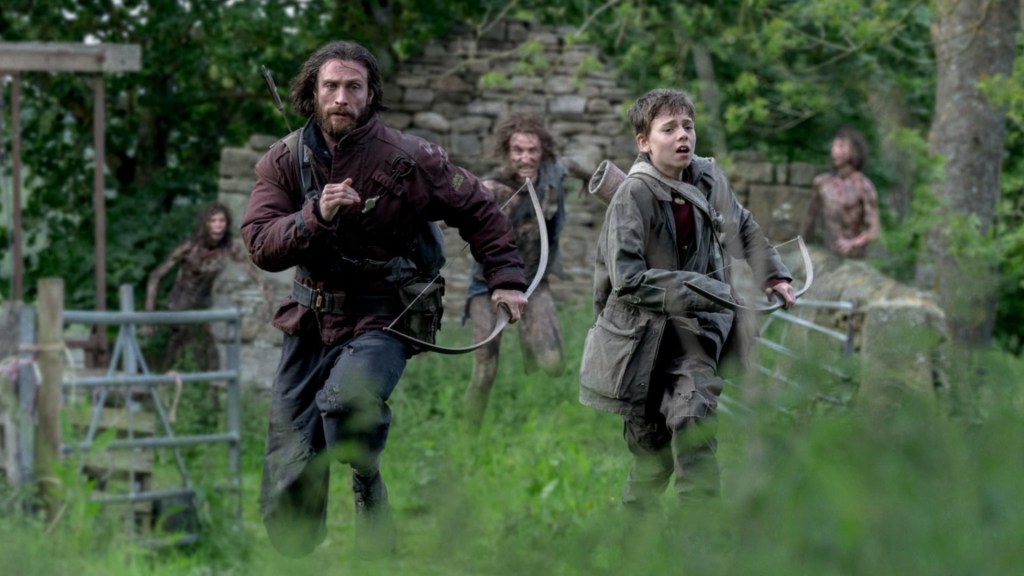
It has been 23 years since the original 28 Days Later sparked a re-ignition of the zombie genre. A bold and revolutionary work that not only redefined the genre, but introduced us to stars like Cillian Murphy and Naomie Harris and allowed Danny Boyle the chance to showcase his Dogma95 traits to the mainstream. That film, shot on mini DV camcorders, with set-up location shots that would be impossible to film today, gave the film a raw, grungy edge that felt tactile and real, gross and stunning all in the same shot. After a slightly disappointing sequel 28 Weeks Later, released in 2007 with no involvement by Boyle (outside of its opening scene) or writer Alex Garland, the franchise had remained dormant, with fans pleading for a Months Later return. Unfortunately, it has been too long to title a third film Months, but that didn’t stop Boyle and Garland from finally returning to their roots and creating a new trilogy, beginning with this film, that allowed both, with their now high-profile name credits, to reinvigorate themselves yet again. What Boyle delivers here on a directorial level feels more free, experimental, liberating, and exciting than any film he’s made since Slumdog Millionaire (although we must give flowers to the criminally underrated Steve Jobs.)
This new story follows a young preteen boy named Spike (Alfie Williams) living with his rough-and-tough father Jamie (Aaron Taylor-Johnson) and sick mother Isla (Jodie Comer) in the small island village Lindisfarne. Lindisfarne is connected to the Scottish mainland only by a causeway on low tide. Jamie takes Spike on a ritual bonding trip to the mainland as the town right-of-passage, teaching him hunting and survival. Isolated on the mainland, though, is a hoard of Rage-virus infected, who had taken over *ahem* 28 years ago. This time, there is even a leader. A terrifyingly large, and seemingly un-killable brute they call Alpha. It is on this land that Spike discovers the existence of a former doctor, Dr. Ian Kelson (Ralph Fiennes) the village has outcasted, living deep in the land, who is rumored to have went insane. Having a sick mother, and a village with no one to tend to her, Spike makes it his mission to find Kelson and save his mother’s life, all while fending off an island of fearsome killing undead.
What works unsurprisingly well here is Boyle tapping back into the coming-of-age genre. Having crafted the Best Picture-winning Slumdog Millionaire (2008) and the underseen Millions (2004), Boyle can throw children into some painful living situations and still pull through a triumph of the human spirit. His quick-cut, maximalist energy woven together with passionate heart has been his sweet spot and he applies that same vision here, a story about a child who is doing everything in his power to save his mother. That level of emotion and life-affirming humanity is what was missing in the franchise’s previous entry and what made the original such a riveting experience.
The surprisingly uplifting nature of the film does not take away from how scary this movie still is. The Rage-infected hoard is still just as frightening as they were in 2002, still able to run at accelerated speed (as stated in the film, the virus acts like a “steroid”). Boyle implements a red night-vision lens over sequences of the creatures communally hunting and killing at night, blurred in with haunting nightmares Spike has on his journey. The use of iPhone photography is noticeable from its first scene and only adds to the raw sense of panic and danger. The camera setups are immaculate as well. There has been some behind-the-scenes photography showcasing the 20-iPhones on a rig for one shot and the Matrix-style effect it achieves works brilliantly onscreen.
Alfie Williams carries most of the film on his shoulders and does so maturely and confidently, a young actor with an incredible career ahead of him. Taylor-Johnson is an impressively complicated father figure, presenting such a roguish, charming, heroic demeanor with self-inflicted demons of his own. Comer, while bed-ridden for the first act, becomes the tender heart of the film, facing her own mortality with sweet and fragile compassion. What can be said about Fiennes’ mystery role is that he is immaculate. A secret weapon deployed in the film’s final act. What he brings is something so unexpected, it can only be witnessed within the film itself. John Murphy’s original music themes are missed, but the new music by Young Fathers is a dynamic, propulsive and beautiful audible experience on its own, adding wonderful levity to both the film’s most frightening and heartbreaking moments.
As the first part of a trilogy, the next installment The Bone Temple being released next January and directed by Nia DaCosta, story threads are not totally complete. The emotional journey feels fulfilling on its own, but this feels only like a nugget of the entire arc Boyle and Garland have concocted together. In what may be the most WTF ending of the year, they shock and surprise us with something so radically, tonally bizarre that may either turn audiences away, or leave them breathless for more. Boyle has always been a director untethered to the rules of filmmaking and somehow he’s still finding ways to break them all over again.

 jakobtalksfilm.com
Leave a comment