
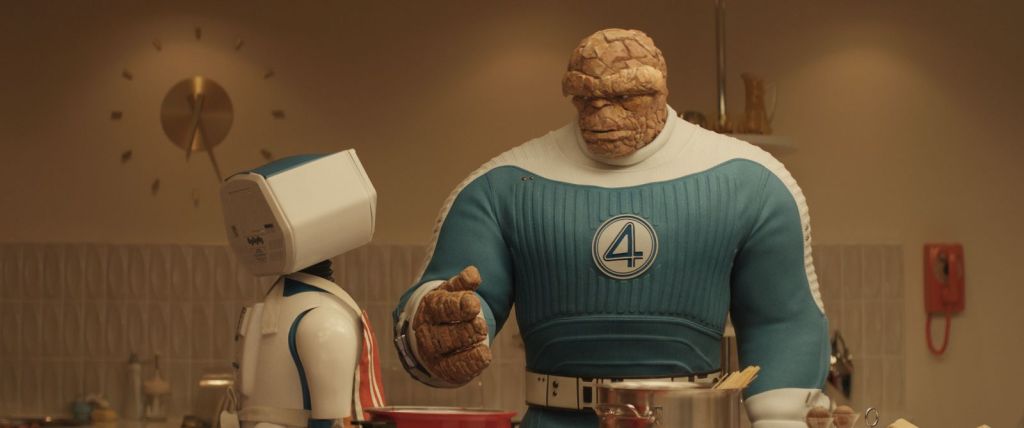
It was quite the low bar to clear in being the best film made about Marvel’s first family. It seemed incredibly likely that finally integrating the Fantastic Four into the Marvel Cinematic Universe after decades of rights issue conundrums and two failed reboots from 20th Century Fox would be the secret ingredient. But has this group needed a secret ingredient? Why were these characters consistently underserved cinematically (and at times disastrously) while their counterparts thrived? Hell, for every not-good X-Men movie Fox produced, they usually made up for it with a good one. It was about time that the pieces fell into place the way they should have, with a great creative pitch and team assembled by director Matt Shakman (WandaVision) and a solid cast. Just based on aesthetic alone, there was wild optimism for this film from fans, even if it doesn’t get the chance to ride the wave of successes that its predecessors pre-Avengers: Endgame did. Sadly, we have been in the middle of Marvel Studio’s lowest point as a company, suffering from a handful of recent bloat and bombs. While incredibly overdue, The Fantastic Four: First Steps may be coming at a time to be the late-arrival hero that saves its studio’s brand.
Set in an alternate-universe, drenched in gorgeous 60’s retro-future detail, Reed Richards AKA Mr. Fantastic (Pedro Pascal), his pregnant wife Sue Storm-Richards AKA Invisible Woman (Vanessa Kirby), his brother-in-law Johnny Storm AKA Human Torch (Joseph Quinn), and his best friend-turned rock monster Ben Grimm AKA The Thing (Ebon Moss-Bachrach) have been the saviors of New York City as The Fantastic Four, celebrating their first four years with their cosmically-gifted powers. After a chrome-skinned herald Shalla-Bal (Julia Garner), also known as the Silver Surfer, arrives on Earth with a terrifying message announcing that her leader, a planet-eating God named Galactus (Ralph Ineson) is on his way to make their home his next meal, the four must work together to devise a plan to stop him, no matter how impossible it may seem.
As dated and poorly-directed as the previous entries were with this team, the one element that feels missing from this version that those versions still maintained is the team dynamic, the bickering, the character-building, and a more substantial use of their superhuman powers. Foregoing the origin story is a nice touch, but it does cause a feeling of detachment from these characters as they’ve seemingly gotten past their traumas already. Much like with this year’s Superman, we are just thrown into their lives and having to catch up with them as best as we can with what context we have. While Superman had an issue of “too much happening”, Fantastic Four has one very simple objective story, told in under two hours, and yet still not enough moments designed to individualize these characters based on their traits, histories, and differing opinions. They simply just… get along and agree. Pascal, Kirby, Quinn, and Moss-Bachrach have great chemistry with one another and feel immediately engaging as our titular heroes, but one would hope a sequel will finally get into the stuff that makes these characters tick (although unfortunately we are rushing them right into two Avengers movies instead).
Regardless of what feels missing from this film, in comes the confident vision of Matt Shakman. Shakman, who stunningly recreated period detail through the world of television to perfection, brings his razor-sharp and cinematic eye to this story, dousing it in fabulous production design (pop art, conversation pits, robots, tube-television screens, pastels!) and even taking inspiration from the visuals of Christopher Nolan’s Interstellar for its space-set sequences, specifically one stand-out cosmic sequence in the film’s middle. All of this set to Michael Giacchino’s delightfully earworm score grant the closest thing we’ll see to a live-action version of The Incredibles (though God forbid the day Disney inevitably announces that remake). Minus the uncanny valley of an occasionally-CGI baby, the use of practical sets, miniatures, and polished work on its cosmic villains that actually feels like it was given time to be perfected add to a sense of relief that perhaps the MCU’s recent visual effects controversies have finally been adjusted to something acceptable again. Captain America: Brave New World, this is not.
In terms of films released by Marvel in the last year, only Thunderbolts* really felt like it has the complete package, delivering great character work with a unique vision and standing out on its own outside of its larger cinematic-universe ties. That isn’t to say, The Fantastic Four: First Steps doesn’t come close. While it isn’t the great film it should have been, it has enough about it that works to continue Marvel’s possible upward streak. If anything, it proves all along that the Fantastic Four in film could have been done successfully all along. Why it wasn’t is beyond us all. Perhaps “four” tries was the magic number.

 jakobtalksfilm.com
Leave a comment