
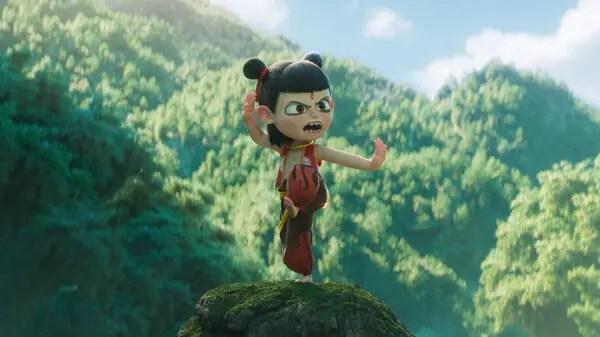
For the average American, Ne Zha may be a title only a minuscule amount of filmgoers were made aware of prior to 2025. The odd disparity between the United States and the Central Kingdom has begun to tilt into in the latter’s favor, with an increasing demand for more films from overseas to be distributed to American audiences, while American blockbusters have continued to massively underperform, or not be distributed at all in the second-most populated country in the world. Director Jiaozi’s orginal Ne Zha from 2019 was a smash hit in China, grossing over $700 million and creating a new pint-sized animated hero in the form of a young boy born from a Demon Orb, while not making a peep in the United States. Six years later, Ne Zha 2 took China by storm, becoming their highest-grossing film in history with over $2 billion and claiming the title of 5th highest grossing film of all-time period. After having a quiet run earlier this year in the States, studio A24 took it upon themselves, post-box office phenomenon, to give the film a fresh re-dub and release it back into theatres, 3D showings included, and the financial results so far are unfortunately better left unspoken. Yes, the Americanized version is probably more flawed (it is the only version I’ve gotten to see), but as a pure action spectacular, it remains a pretty enthralling time regardless.
Based on Xu Zhonglin’s 16th-century novel Investiture of the Gods, the original film’s backstory involves a destructive elemental force known as a Chaos Pearl causing havoc and absorbing the world’s energies. After splitting the Pearl into both its kind Spirit Pearl and its Demon Orb, Lord Yuanshi Tianzun bestows responsibility on his two disciples, Taiyi Zhenren and Shen Gongbao, to distribute the Pearl to be reincarnated as the soon-to-be-born Nezha (son of Chief Li Jing) while the Orb is to be destroyed by heavenly lightning in three years time. Due to a jealous switch-up between the disciples, the Demon Orb is reincarnated as Nezha instead, creating what can only be described as “what if Bart Simpson had demonic superpowers”. The Spirit Pearl becomes the virtuous-but-conflicted Ao Bing, son of the Dragon King. After a cataclysmic battle, Nezha and Ao Bing set aside their destinies and differences and join together to stop the lightning from destroying Nezha, both Yin-and-Yang, though in the process, become spirits. (Keeping up?)
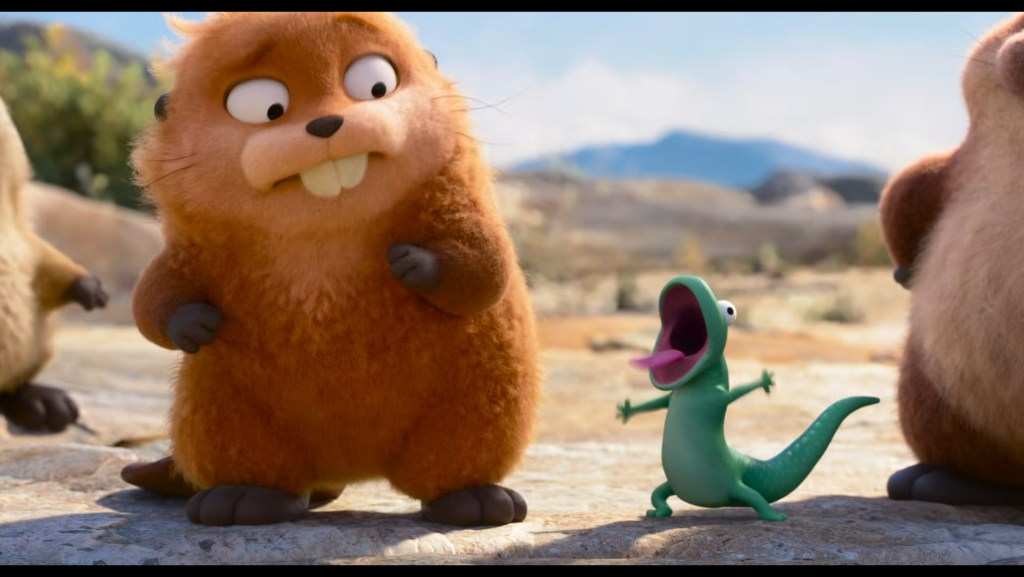
The sequel picks up almost immediately after, with Nezha and Ao Bing’s bodies being newly formed by Taiyi using the seven-colored lotus flower. After a sudden attack led by Shen, Bing’s body is prematurely destroyed, and Nezha allows his new body to act as a host for both of them (Americans, think Swayze in Whoopi’s body in Ghost) until they can successfully complete a set of dangerous trials to gain immortality, be rewarded the antidote to regaining the lotus flower, and form new bodies again. Though despite the challenges of the demon-slaying rituals (one hilariously against an army of adorable marmots), a greater evil force works to disrupt the balance of the universe, leading to a gargantuan battle between Gods, humans, spirits, creatures and shape-shifters alike.
Everything in Ne Zha 2, compared to the original, is enlarged, with a massive scope that delivers intense thrills, eye-popping visuals, gorgeous animation, and powerfully touching beats. While the story may be dense for those going in completely fresh, all of the table setting is worth the rollickingly entertaining and extravagant set pieces, each more investing with the next, while sneakily weaving its characters into situations that push them beyond their emotional stability. With the new English dub, A24 hired the legendary Michelle Yeoh to add star-power to the US re-release and while her voice does stick out jarringly compared to the rest of the cast and the role of Ne Zha’s mother, Lady Yin, isn’t given much to do in the first half of the film, Yeoh gets a worthy, standout moment to shine in the finale. Nezha’s new vocal dub, Crystal Lee nails the emotional mood-swings of our titular hero, though stumbles a bit with the comic dialogue, which could be blamed more on tough language transition.
While having less juvenile humor than the first (which was hampered by piss and fart jokes to please children), some of it is still intact here, and the English translation isn’t perfect (yet far from the worst English dubbing). Beyond that, though, the storytelling is what makes the Ne Zha franchise work, with its wide array of characters both having to make incredibly difficult sacrifices while also going down unexpected paths, with each of their journeys find new, compelling layers. Ne Zha built impressive groundwork, while Ne Zha 2 feels excitingly untamed, always yearning for bigger and more complex.
Jiaozi’s canvas feels unlimited, treating his animated world like a full-scale action-blockbuster, with a nearly 150-minute runtime, that will you on an exhausted, but exhilarating high. Whether that resonates with the casual American audience is superfluous compared to its success in its home country, where it really matters. But there is something about seeing that short, little demon child with large smoky eyes and round teeth kick ass on the big screen that feels instantly, cinematically iconic. A feeling that perhaps America is missing out on something special after all.


 jakobtalksfilm.com
Leave a comment