
While “the revolution will not be televised”, it’s certainly up there on the big screen. Paul Thomas Anderson, who has for his entire career made decade-defining films from Boogie Nights to Magnolia to There Will Be Blood, has perhaps made his most instantly generationally-potent film to date with One Battle After Another. In what is a long overdue collaboration with lead star Leonardo DiCaprio, who was nearly our Dirk Diggler, Anderson has made the most exciting, propulsive, fast-paced, accessible and crowd-pleasing film of his career and yet sacrifices none of his cinematic genius to get it made. For what is supposedly budgeted at $140 million dollars (more or less depending on the source), one may be curious if he’s bit off more than he can chew. Anderson is not one to make films for large audiences just popping into the cinema to have a good time. His films are risky, and mostly appreciated by cinephiles who even themselves may need some time to sit with what he’s made. The political nature of One Battle After Another may be questionable to some, particularly coming off one of the most divided eras in American history (with no end in sight). The film literally opens with an attack on an ICE raid, which may instantly recall the recent news out of Dallas the same week the film is being released. But, the intentions aren’t to glorify one side or the other. The heart of the story is front and center: a father whose past mistakes have come back to haunt him, a daughter brought into this world who didn’t ask for any of it.
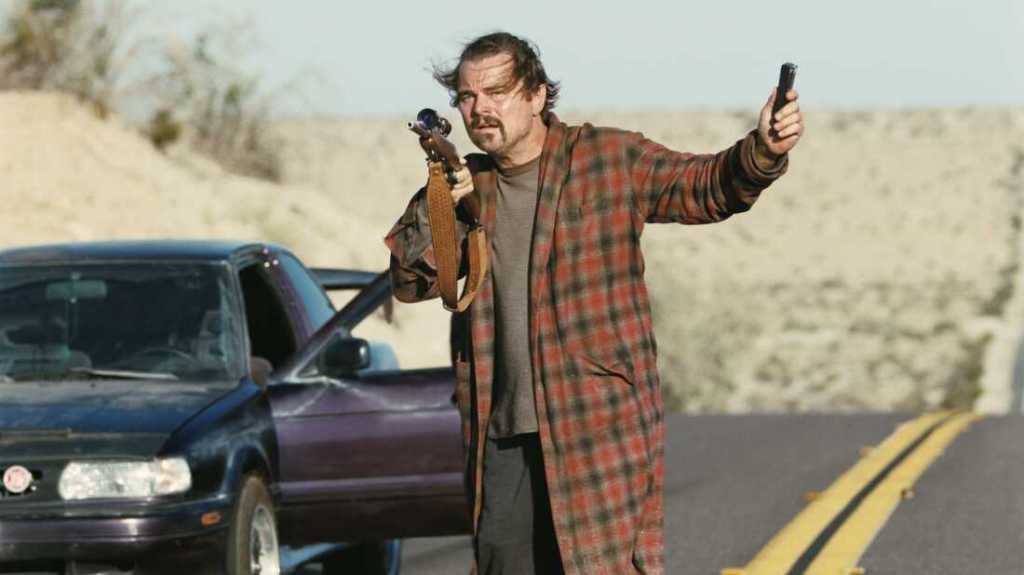
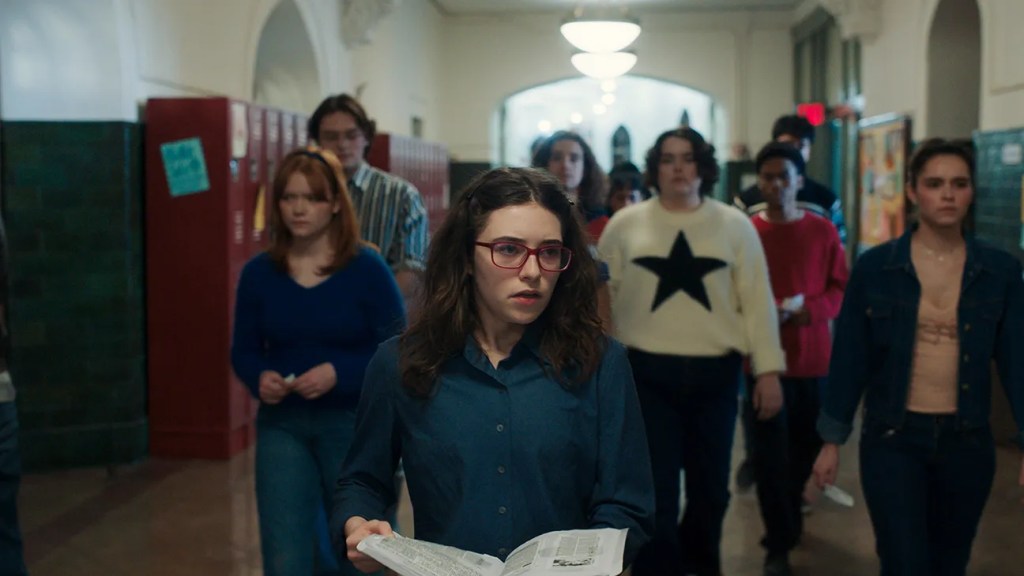
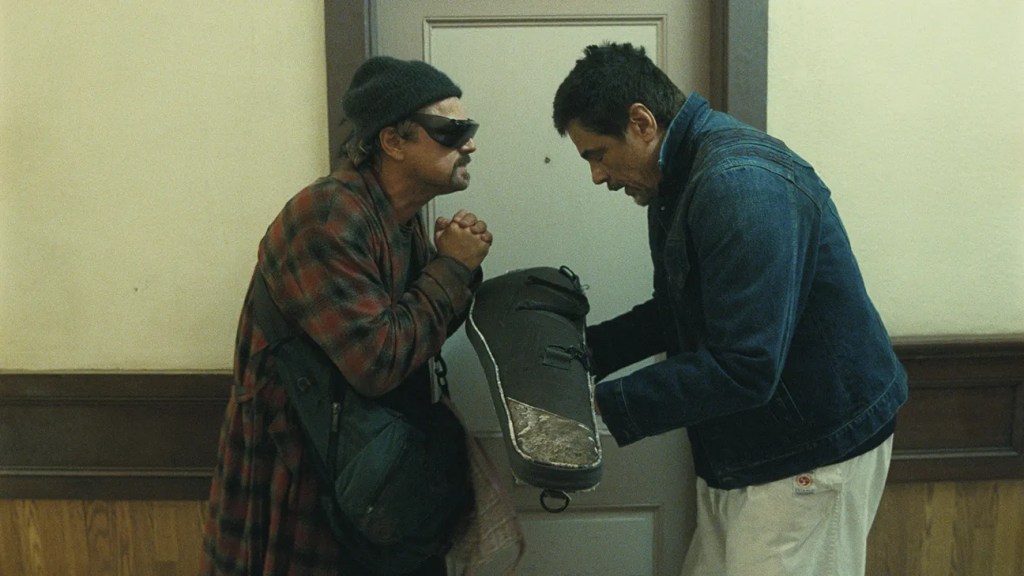
The father,”Ghetto” Pat Calhoun (Leonardo DiCaprio), a member of the French 75, an anti-fascist leftist revolutionary group who raises a child Willa, formerly Charlene (newcomer Chase Infiniti) with his lover Perfidia Beverly Hills (Teyana Taylor). After getting entangled with the vile and hard-edged officer Capt. Steven Lockjaw (Sean Penn), Pat and Perfidia’s mission is compromised and both are separated and sent into witness protection. Soon after, Perfidia goes missing. With new identities, Pat becomes Bob Ferguson and Charlene becomes Willa Ferguson. For years since, Bob has kept Willa under his fragile wing, a father constantly fearing for his daughter’s safety in the event that his past identity will inevitably collapse their humble new life, not even allowing her or himself to have a cellphone in case of being located. Willa, despite her dad’s odd behavior, has grown up to be a free-spirit, even taking self-defense karate classes taught by her sensei Sergio St. Carlos (Benicio del Toro), he himself secretly a revolution member himself. She’s formed a quaint but healthy social life, and though Bob is irrationally alarmed by their existence, he knows his daughter has to live a normal life.
Bob, since leaving the French 75, has settled into becoming quite the harmless burnout, satisfied with just smoking a joint on his couch and watching old films. Willa, wise beyond her years after growing up with Bob’s odd training, takes care of her dad more than he’s able to take care of her, and yet Bob still sees her as a baby bird he doesn’t want to leave the nest. Everything crumbles when their identities are discovered by Lockjaw. Once Deandra (Regina Hall), a former French 75 member, shows up at Willa’s school dance and proving herself immediately to be trusted ally of Bob, Willa must abandon everything and be forced to go on the run. Separated from his daughter, Bob must get back into action and back in contact with his former group, aided with the help of Sergio, despite a corroded brain abused by drugs and alcohol affecting his ability to remember passwords and secret phrases that will grant him permission of information of his daughter’s whereabouts.
From then on, One Battle After Another is a breathless chase movie. A riveting thrill-ride, aided by Anderson and Michael Bauman’s gorgeous Vistavision-shot cinematography and a thrilling score by Jonny Greenwood, whose fervent high-pitch piano keys do as much to provoke a pounding heart as the theme from Jaws. Car chases are seemingly shot from the bumper point-of-view, zooming up and down enormously steep empty highways to brilliant effect. Not since Mad Max has anyone utilized the cinematic power of a single strip of road. Every cent of the budget seems perfectly used in creating tremendously-blocked chase sequences, from rooftops through giant protest crowds into speeding vehicles. Anderson, known more recently for films with an intoxicatingly languid pace, has switched his gear entirely. For a film with a 160 minute runtime, not a minute feels wasted, every sequence seemingly flying by to the next. By the time the credits roll, you may not even feel ready to leave the world he’s created behind.
While often incredibly tense, Anderson’s brilliant script (loosely based on Thomas Pynchon’s novel Vineland) is full of laugh-out-loud lines and characters so absurd, yet so fully realized. Sean Penn’s despicable Lockjaw is almost cartoonish, with a grumbled, gritted voice just a hair off of RFK Jr.’s, with a goofy haircut styled with his saliva-coated comb. His obsession with finding Willa and earning his place into a secret society of white supremacists is driven by a child-with-a-tantrum-like attitude. Yet, he’s still terrifying, an unsettling presence every second he’s onscreen, walking into the frame with almost the same level of dread upon the audience as Anton Chigurh. Benicio del Toro’s Sergio is on the opposite end of the spectrum, being a reliable beacon of help and a welcoming dose of broad humor. Chase Infinti feels revelatory in what is only her first film role. A commanding young star, who rises to the level of her A-list costars.
Then of course, there’s Leo. DiCaprio, who has in the last decade and a half has proven to be an shockingly funny lead when given the opportunity (a muscle he finally flexed in full with The Wolf of Wall Street and carried over into films like Once Upon a Time in Hollywood and Don’t Look Up). Bob Ferguson is easy crier, a mush-hearted dad who only wants the best for his kid. His empathy was what drove him to be a radical in his younger years, yet now has worked against him. He couldn’t be less tempted by “domestic terrorism for a humanist cause”, instead funneling all of his sensitivity and compassion into raising his daughter. DiCaprio, known for being the most movie-star face of his generation, believably transforms into a crusty, washed-up has-been and balances hilarious frustration with open-hearted vulnerability.
Within a story of violent extremist dueling sides is simply just about a father who isn’t ready to pass the baton to his child of a new generation, which layers the entire film with an unexpected tenderness that should connect to viewers of any political designation. Family is universal and no matter what you spend your life fighting for, you will always fight for your kid first. Anderson has made a generational American film, one that I can imagine will be discussed for decades, one that speaks to the hysteria of this generation and the hysterias of generations past and future to come. A rally cry for the ages. Viva la Revolución!






 jakobtalksfilm.com
Leave a comment