
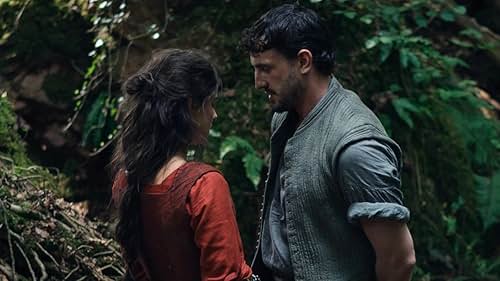
“Where is he?” William Shakespeare asks, having returned home from London, arriving moments after the unexpected death of his son Hamnet. He sees his son’s body and is incapable of processing the loss of the child in front of him. His daughter is also in denial, unconvinced the body is even her brother. His mother Agnes, seems to suffer the worst, feeling responsible and begging the universe around her to return her son. Where is he? Where do we go when we’re gone? How do we keep our loves ones around when they’re no longer here?
A story as heart-wrenching as this demands a vision with the most empathetic eyes, which is why it’s such a perfect fit for Chloe Zhao. The Oscar-winning filmmaker behind Nomadland and The Rider, returns to her wheelhouse of quiet, intimate human stories after the ambitious big-budget misfire of Marvel’s Eternals to deliver her deepest and most powerful exploration of the beating heart to date. Based on the novel Hamnet by Maggie O’Farrell, the film stars Jessie Buckley as Agnes Shakespeare and Paul Mescal as the most celebrated writer in history in the story of their courtship, the raising of their family, his blossoming career as a playwright, and most tragically, the loss of their son Hamnet (Jacobi Jupe), who goes on to be the basis of inspiration for Shakespeare’s Hamlet.
While the story is steeped in pain, Zhao understands that love comes first, allowing us far more time than expected being introduced to our leads and what led to their enchanting romance, as well as the tight bond they had with their children. Agnes, a “daughter of a forest witch” as known by town gossip, is a unique personality, a medicine-maker with an attachment to the expansive, gorgeously-green woodland area that surrounds her home. Her wild mind attracts William, a man whose imagination is too big to contain in his own head. Despite the demands of his intimidating father John (David Wilmot) and hard-to-please mother Mary (Emily Watson), William’s passions were in his writing. After his first encounter with Agnes, William sits with a quill by candlelight and his infatuation inspires a certain, familiar passage from a future tale. As he is blessed with three children by his wife, he begins to earn a living through his gifts. When away, he takes part in a traveling theatre group in London, and when home, he concocts fantastical, sword-fighting plays for his children to perform. The seeds of these small, playful performances also unmistakably to become some of the most notable work to ever be written.
Mescal is unsurprisingly remarkable, portraying William with gutting, transparent intimacy, able to exude so much emotion, charm, and crushing devastation with just his big, sad eyes. A generous comparison, but not unlike the great Orson Welles, Mescal as an actor, despite his young age, has the capabilities, the presence, and the prowess of a performer with decades of experience under his belt yet still at the mere beginning of his career.
Jacobi Jupe as Hamnet is a revelation. Barely adolescent, Jupe is capable of tackling the complex enormities of his tragic fate and matching the emotional honesty of his adult costars while also giving Hamnet an effortlessly charming soul of his own during his time of living. (His real-life brother, Noah Jupe, brilliantly cast as the actor playing Hamlet on stage, who also impresses greatly with his vocality and command of the stage).
Yet, while also to commend the brilliant production design, stunning naturalist photography by Łukasz Żal and quiet but potent score by Max Richter, the film belongs to Jessie Buckley, who carries most of the film’s shattering weight on her shoulders. A performance so tethered to the strength of motherhood and burdened with overwhelming, overflowing love. Buckley achieves extraordinary levels in portraying the spectrum of grief, going to places of unrelenting heartache to near total loss of feeling, yet still wrapped in a soul that remains ethereal. Her final minutes in the film just pure breath-taking. Sure to be one of 2025’s most defining cinematic moments.
We all will face loss as inevitably as we will face dying ourselves, but death does not have to mean non-existence. Life exists as long as art persists. Stories live on, as does music, poetry, books, movies, always keeping the voices and inspirations alive to continue telling us theses stories again and again. Hamnet is a reminder that processing grief through art is a beautifully common experience, as painful as it is healing. Why let anyone die forever? Why not let them metamorphose into something new? “To be or not to be?”, that is the question.





 jakobtalksfilm.com
Leave a comment