
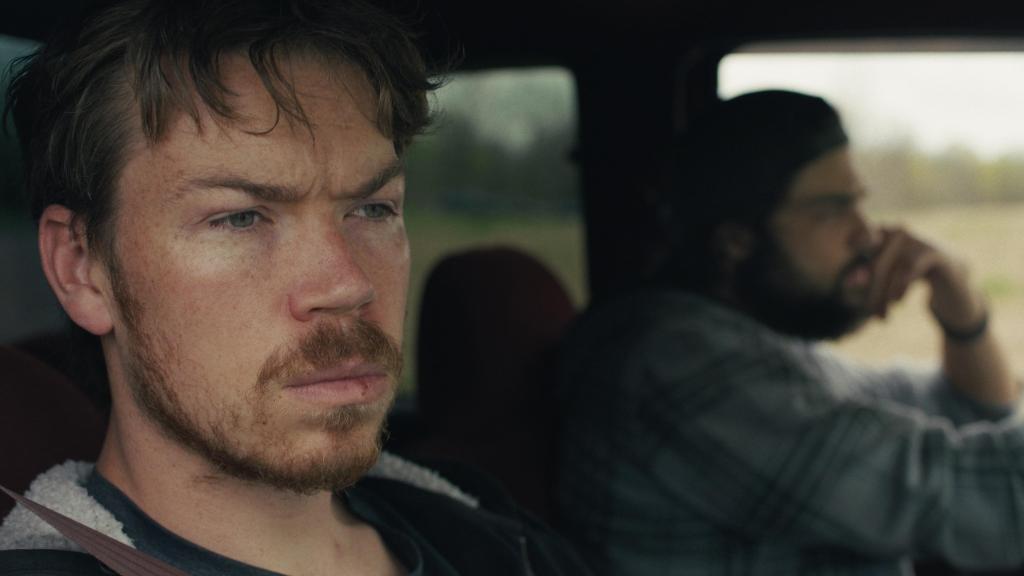
“You haven’t caused any problems… yet.” A simple, but damning reminder Cody Parsons (Will Poulter) receives during one of his assessments early in the new debut film by Adam Meeks, based on his 2020 short film. It’s true that Cody feels healthy, capable, and confident while taking part in his four-phase, 18-month opioid recovery program. But what is 18 months to a normal person can feel like years to an addict. All it takes is one lonely moment of boredom.
Meeks’ dedication to honoring the truth of the struggles of recovery are notable within the very first shot of the film: Cody, slightly off-screen, sitting amongst a group of real addicts giving truthful testimonies, all filmed in cooperation with the Adult Recovery Court in Ohio. The authenticity is strikingly apparent. When Poulter and fellow co-star Noah Centineo, playing Cody’s foster brother Jack, do take center stage within that scene, their faces are familiar, but their performances read true. This is the first major success of the film, believing these performers in this very real and sterile environment.
Both brothers are stuck in this situation, a cause of poor influences that grew into an unshakeable, life-threatening problem. Cody is the quieter one, mumbling his words, often timid, and doesn’t jump at the chance to socialize. Jack is the talkative one, the twitchier, louder one who masks the most under a large personality. It’s hard to know what Cody was like before his addiction, if the shame of his enabling of drug use on Jack is the cause of his blankness. In fact, we don’t get truly get to know Cody deeply as a character, which is an issue and an asset to the film. On one hand, he is a conduit, one that can allow anyone that has been in his situation to place themselves in his shoes easily. On the other, the film becomes a bit too anonymous. One about the greater issue as a whole rather than a singular, original story, which can feel like a sad PSA. Something that would have been more effective as a documentary about the program as a whole.
But Union County does very little wrong in its depiction of these patients, taking truth into account at every corner. The minute Cody is left alone, depression catches up to him. For someone that basically lives in his car, he doesn’t have enough going on to even distract himself. He does secure a job at a sawmill, trained in by Jack, but the overt simplicity of slicing wood with a demolition saw for hours on in feels meaningless. After a major incident, the boys are separated. Jack is moved into intensive treatment while Cody is moved into a sober house. Neither can truly be together without digging their worst instincts back up from out of the ground. “Get yourself around good people,” is the best advice Cody hears. Easier said than done.
The one good person in his life outside of the program is his sister Katrina (Emily Meade), who is the “stable” sibling of the three, yet single-parenting her young daughter, alone in her own way and mourning the time she’s losing with her siblings. Cody does strike a comforting relationship with Anna (Elise Kibler) who works with peer support across the street from the sober house. Anna’s past traumas give Cody an idea that a healthy life is still possible. Kibler’s presence is a warm beam of light, even if you know it’s going to take more than her existence to keep Cody on the right path.
Poulter excels in emoting internally, allowing us into Cody’s tortured mind through visible resistance and embarrassment, gentle reactions, and pained eyes. The first moment the camera focuses on Poulter, it does feel like he’s been lost in this performance long before walking on set. It’s a central topic that probably means a lot to the actor who also participated in the 2021 Emmy-winning limited series Dopesick. Centineo (whose notable likeness to Mark Ruffalo is even more apparent here for anyone who has seen the Kenneth Lonergan masterpiece You Can Count on Me (2000)) is incredible impressive, shedding every bit of the golden retriever image he showcased in his early teen-targeted breakout appearances. Centineo’s body movements, his posture, his speech patterns feel frighteningly real, but with it is a sensitivity that quietly and tragically translate to us the person inside begging to be free.
Union County is not an ambitious film. It’s not going to be the movie that solves the opioid crisis. It is a slight slice of reality. One story out of millions. A reminder that everyday is a lifetime to those affected and those waking up every morning with a clear mind and conscience is nothing short of a blessing.




 jakobtalksfilm.com
Leave a comment