
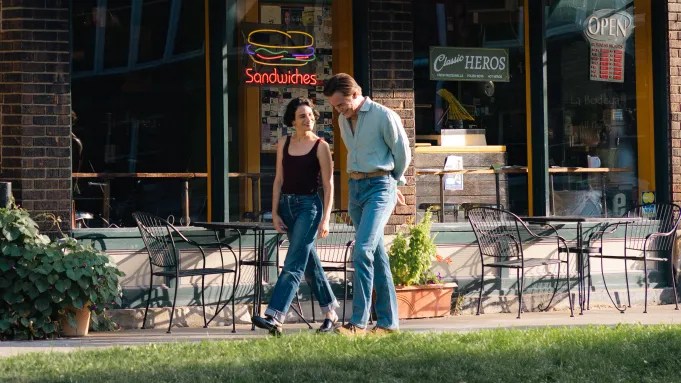
Rachel Lambert made a Sundance splash back in 2023 with her Daisy Ridley-starring Sometimes I Think About Dying. That charming oddball of a film found bountiful sweetness in a quirky premise about an even quirkier lead character, but due to Lambert’s affectionate and dream-like direction and Ridley’s earnest performance, both the humor and heart landed in spades. Lambert, for her second feature, chooses to reign in rather than expand her horizon with an even smaller and more reserved story about two lovesick people whose priorities in life just can’t seem to stay parallel.
Chris Pine stars as Noah, a doctor working at a family-operated clinic. With his divorce finalized, his longtime mentor Sam (Sam Waterston) retiring, and his daughter Maya (Abby Ryder Fortson) going through high-stress anxiety over academics, Noah’s commitment to keeping everything in his life stable begins to take a toll on his emotional state. That’s when he spots Rebecca (Jenny Slate), the former flame of his youth. Their lives took different directions when Rebecca chose to leave Ohio to work in politics in Washington D.C., but now she’s in town to settle some personal matters, including her parent’s inability to sell their home, as well as setting her own life straight. Their reconnection moves even faster than either of them are prepared for, leading to romantic flings every weekend his daughter isn’t home. Neither of them can really function alone (Noah is prone to frozen pizzas and beer every night, Rebecca uses her car like a trash can), and when they are together, they seem to be at their best, but both know this is just temporary.
To start with the film’s biggest strength, Pine and Slate are tremendous, giving possibly career-best work. Both are raw and vulnerable in expressing their doubts and fears about the future. They feed off of each other’s likability and nakedly tender fragility. Pine has never been this delicate and flawed on screen before, often masking his insecurities and turmoil by slipping into (as Maya calls it) “doctor voice”, a great use of Pine’s natural sultry-toned speech. Slate gives Rebecca a self-deprecating edge, self-aware enough to own her own problems and yet be a source of open-hearted comfort to both Noah and Maya as they battle their own complicated messes. One standout moment in a kitchen in the film’s final act is a tremendous showcase for both actors, expertly channeled into their character’s broken history, enough to put a lump in any viewer’s throats.
Lambert’s writing intentionally shades her lead characters with impenetrable self-destructive obstacles. They are their own worst enemies and it is neither their fault or anyone else’s. With every reward in life comes a random sacrifice that no one is ready to make. Noah and Rebecca break each other’s hearts being in the same space together, yet are lost souls when they are apart. While it is true to the confused nature of love, the push and pull of what the heart wants in a given moment, the story structure does start to feel a bit untethered in the back half. Perhaps the premise is just too simple. So much is intentionally left unspoken between the two that the audience isn’t immediately locked in on why these two are so drawn to each other (outside of the performers’ chemistry) and as the tide begins to pull them apart in the second half, the narrative begins to feel as discombobulated as its characters. While it comes to a satisfying-enough close, there is just something missing in the script to give it a real memorability.
Lambert’s portrayal of this romance is so subtle and reserved, which works as both a strength to the actors and a bit of a loss to the audience. The camera will often frame the performers at a distance and let them get impressively lost in the scene, but its quietness doesn’t always allow the viewer to feel the swell of passion the leads are experiencing. Dustin Lane’s 35mm cinematography is beautiful though, as is Dabney Morris’s enchanting music, and the script is able to unlock enough relatable truths about the multifaceted human condition to make it worth the investment. It may not be the major level-up you’d hope after Sometimes I Think About Dying, and it has no ambition to be, but Lambert has such empathy for her characters, there is enough reason to give your heart to it anyway.




 jakobtalksfilm.com
Leave a comment