
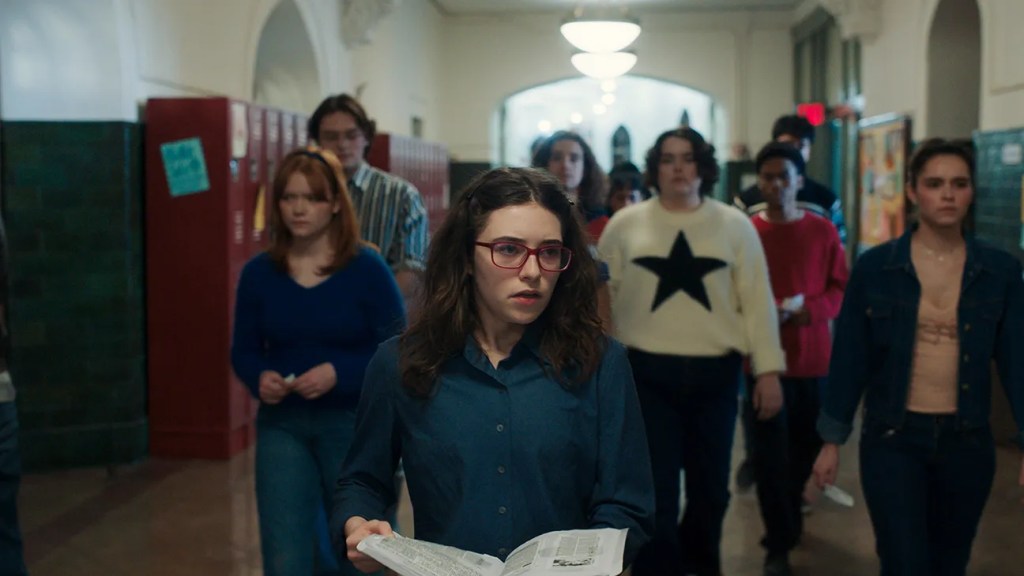
There were 230 instances of school shootings in America occurring just in 2025 alone, and that was just a mild drop from the year before. To call it a sensitive topic among everyday citizens would be an understatement. In fact, school shootings and inability to maintain sensible gun control, mostly due to profiting politicians, has been plaguing America for decades, becoming a culturally-defining talking point after Columbine in 1999 and later on, Sandy Hook in 2012. NB Mager, who wrote and directed this as her first feature based on her 2023 short film , made Run Amok! as her way of portraying what she wishes she could have done in her own youth, with the character of Meg being her pint-sized surrogate. It’s true that humor can possible in any circumstance, as can joy and uplift, no matter how impossible it may seem. Meg’s (and Mager’s) plea for allowing catharsis in a dark time is indeed noble, but yet still ends up feeling tasteless.
Meg is played with impressive confidence by Alyssa Marvin, an outcast high schooler who lives with her aunt Al and uncle Dan (Molly Ringwald and Yul Vasquez), as well as her cousin Penny (Sophia Torres). Meg’s mother was a former teacher and the unfortunate victim of a mass shooting that occurred at Lincoln High School almost exactly 10 years ago. To honor the lives lost, the school is planning a commemoration event and offers Meg the chance to put on a theatrical production with other students that helps memorialize the lives lost. A daunting task to put on an individual whose life is so tragically linked to the event, but Meg is up for the challenge, especially with the support of her music teacher Mr. Shelby (Patrick Wilson).
However, as much as Principal Linda (Margaret Cho) would prefer the musical to be moreso “everyone sings ‘Amazing Grace’”, Meg has a far more ambitious idea in mind: an exact re-staging of the event based on police records and an unflinching retelling set to licensed pop songs like “Hit Me Baby One More Time”, “Bulletproof”, and “Killing Me Softly” (ones that Meg clearly picked because of the title and not because she understands the actual content of the songs). While, Linda is rightfully bewildered by Meg’s direction, the sympathetic Mr. Shelby insists that Meg explore her trauma through art the way she feels best expresses it. As Meg continues to push the boundaries on what is appropriate, in the sudden interest to understand the man that took her mother’s life, she also begins to form an unlikely connection to shooter’s mother Nancy (Elizabeth Marvel).
Tonally, just the premise alone is a tough and tricky sell, one that may have worked better in its original short film format. But spending 96 minutes in this confused headspace causes more moral questions to arise that the film can’t be bothered to tackle. Meg’s musical is technically inappropriate, and yes, while it all comes from her un-matured mind and soul, there is nobody to question her on whether it respects the victims or the victims families at all, nor does it personalize or personify any of the individual lives taken, they are just blank names/faces. The school staff is instructed to carry around rubber bullet guns at all times for defense, yet the woodshop professor Mr. Hunt (Bill Camp) is noticeably mentally disturbed and aims his gun at anything that startles him. The film isn’t sure if it’s meaning to treat this idea as satire or disturbingly real, sometimes its both, and that’s just a nugget of how the film feels as a whole. It wants to be absurdist and quirky, but also burdened with the dark cloud of real tragedy.
There is something oddly approachable about its earnestness at first and the colorful way in which it introduces us to the school’s students and staff, but hits a depressive snag about an hour in, suddenly afraid to commit to its biting depiction of the desensitization and cultural reaction to violence in America and feeling guilty it even tried. There’s a version of this that works, if it maybe were funnier or more blunt. If it scattered its poignant moments only when necessary, or reserved for the end, instead of laying everything so thick for the entire back half of the movie. It can’t seem to handle its shifting tones without feeling like two separate movies. One bold and challenging, the other shrill and overwrought. In the end, catharsis is the last thing achieved by anyone, both by its characters and by us, the audience. A film that is more annoying than it is therapeutic.



 jakobtalksfilm.com
Leave a comment