
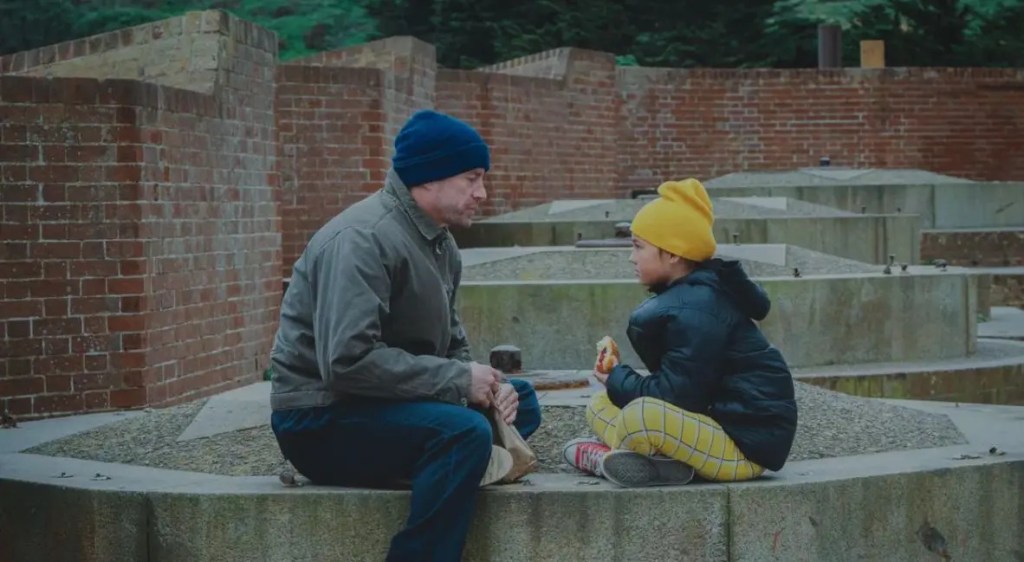
Parenting is scary even before children exit the womb with the work it takes to ensure a safe arrival, as well as the first few months after birth, making sure their small bodies are functioning properly. If no major health issues occur, and your child grows to be an independent, conversational, and well-behaved individual, it can seem like the hard part is over. But statistically and unfortunately, most children experience trauma at some point in their lives, to varying degrees of extremity. Once innocence is broken, it’s basically impossible to be fixed.
Josephine, Beth De Araújo’s harrowing drama about a young girl who witnesses a graphic sexual assault won both the Audience Award and the Dramatic prize at Sundance, a rare feat. Now, just that brief logline may have most people backing away from even the idea of watching it, and the “moment”, shown early on, is brutal. But De Araújo’s focus is heavily focused on the aftermath, with its portrayal of lead Josephine (Mason Reeves) struggling to understand her new discovery of real evil and trying to make sense of it while having two adults in her life with contrasting ideas of parenting.
Her father Damien (Channing Tatum) is an athletic coach dad, who exercises with Josephine every morning and takes her on runs. Josephine and Damien have a very sensitive bond that rarely butt heads. When Josephine discovers the incident early on while on a run in Golden Gate Park, Damien is quick to check on the victim, call the cops, and chase after the assaulter. His insistence on his daughter being mentally alright, given she’s physically alright, causes Damien to not confront the consequences head-on, leading him to assume his daughter is better off taking self-defense classes than seeking a counselor. He knows his daughter has been through a life-changing event, but tries to get her to shrug it off, masking his own heartbreak with relaxed charisma. It’s one of Tatum’s most complex performances to date and watching him make all the wrong choices under the mindset of his brutish character is both fascinating from an acting standpoint and maddening from the viewer’s perspective.
Josephine’s mother Claire (Gemma Chan) is an artist and dancer, whose professional life is performing through expression. She is more the nurture to Tatum’s nature, at first unaware to the extent in which Josephine witnessed the event given her absence, and slowly and surely coming to the insistence that she needs real, hard counseling. Chan is quietly devastating, speaking so much through concerned eyes. Claire has her own faults, unable to manage Josephine’s new erratic behavior in unexpected moments and extremely hesitant to let Josephine be involved in the assaulter’s trial as a witness.
The trial itself is a far more complicated process as the victim has removed herself from the proceeding, unwilling to testify as she processes her own trauma, leaving Josephine the sole witness. Damien wants nothing more than for the legal system to get one more sex offender off the streets, while Claire isn’t ready to let Josephine be front and center in an adult situation and having her be manipulated by crooked defense attorneys while answering graphic questions. There is no easy way out.
De Araújo finds very unique and emotively-detailed flourishes to explore the mindset of Josephine (we literally begin the film with the camera acting as Josephine’s literal point-of-view), through allowing the assaulter that she witnessed to linger around every room corner in her imagination, yet Josephine confronts and conceives this haunting figment a kind presence rather than a frightening one, manifesting him as a real imaginary friend. One particular moment, where a rotating camera is placed at the center of their dinner table, brutally showcases Josephine’s disassociation to reality. Josephine’s mind is never in one consistent place. She’ll distract herself with fantasy, but she’ll ask her parents startling questions or search words online like “raipe”, she’ll act out in random fits of rage, she’ll literally run away from her parents in the streets of San Francisco at a moment’s notice. Her behavior becomes almost unmanageable to a point. Her discovery of evil gets her to question if she has that same evil inside of her.
Josephine does have an oppressive narrative, one that can be extraordinarily difficult to watch, even during its more subtle moments. Having to witness the brilliant young talent of Mason Reeves say and do what she’s tasked with on camera can be a stomach-churning, from verbally detailing the encounter to an obsession of sharp objects to spreading her newfound knowledge onto her school classmates. But Reeves is a massively impressive anchor, at first vacant and quiet, but transformative in her ability to express her inability to understand the basic rules that adulthood forces upon her despite the cruelty they’re able to inflict upon each other.
As with reality, some life situations don’t come with solutions that fix everything, which could leave a lot of De Araújo’s film feeling unfulfilling, an audience stress test with no purpose other than to showcase a terrible situation. Even its music score by Miles Ross is unrelentingly bleak and rattling to express just how horrible the world can be. That’s not to say that Josephine isn’t telling the truth, it’s just a heavy narrative. It’s tough to call it a “cautionary tale” because there seemed to be no way of preventing Josephine’s involvement, if not just to say you’re never truly done being a parent, that one day your child will learn harsh realities beyond your control, and how you choose to handle it could affect the rest of their life for better or worse. A cautionary drama second, a horror film about parenting first.





 jakobtalksfilm.com
Leave a reply to The Minnesota Movie Digest: Issue No. 175 – Minnesota Film Critics Association Cancel reply