
NOTE: Some spoilers regarding a tragic historical event within the film’s plot are discussed in this review.
It’s easy to say that when you’ve seen one horror film about grief, you’ve seen them all, but that isn’t necessarily true. Billions of people around the world experience grief in their own way whether unexpected or prepared, personal or impersonal, generational and cultural. It’s one of the few realities that every single person will experience. Rock Springs, Vera Miao’s directorial debut, takes the cultural approach. The Chinese tradition of navigating the lost and unfortunate souls to their right place during the lunar Ghost Month is an idea ripe for a paranormal terror. Miao starts strong with an unsettling tone and macabre visual backdrops, depicting a void-like dream space that signals to our characters and to us as the audience that they, and we, are entering a doomed location.
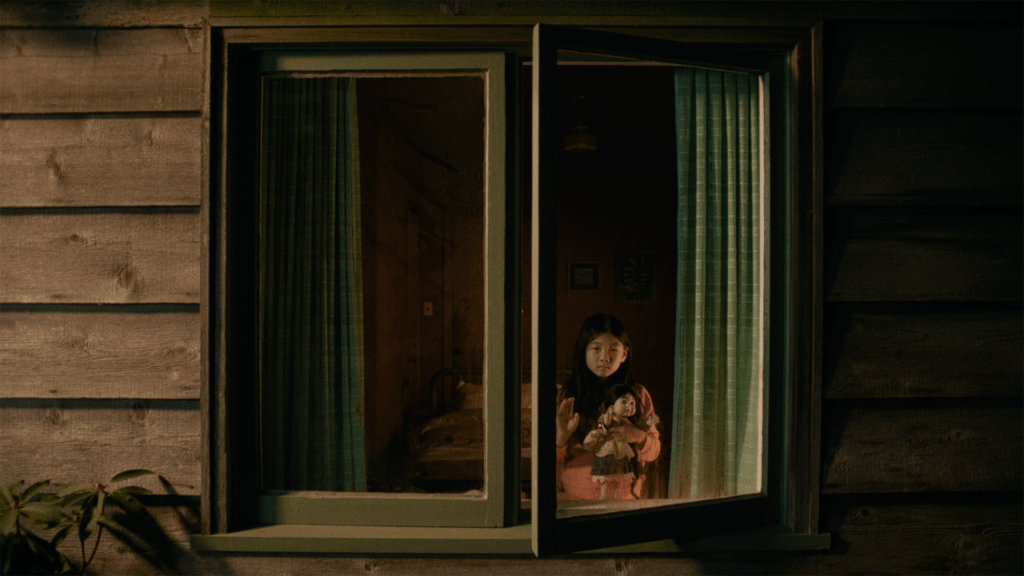
Split into three chapters, we first begin with the perspective of Gracie (Aria Yang), young daughter to Emily (Kelly Marie Tran), a cellist who is moving her and her Nai Nai (Fiona Fu), to Rock Springs after the recent death of her husband. Nai Nai, Emily’s mother-in-law, is close and comforted with her heritage, calmly teaching Gracie how to help her father’s spirit find its way out of the darkness during this sacred month. Emily, trying to adjust to her new life and about to begin a new job teaching at a community college, uses her solo practices as her own emotional solace. While stumbling upon a rummage sale with her mother, Gracie spots a disturbing, but beguiling doll. Unbeknownst to Emily, Gracie sneaks the doll off its display and brings it home with her.
Now, this isn’t exactly a possessed doll movie, but the doll’s significance does eventually prove vital to the film once the film shifts backwards in time for its second part, focusing on the very true and tragic Rock Springs massacre of 1885, where an uncle (Benedict Wong) and his nephews, working as coal miners amongst a whole Chinese-settled community that soon were horrifically and brutally slaughtered by racist white miners. Wong’s performance might be the most compelling of the entire film, as he performs the heroic and unimaginable duty of guiding his family to safety with no clear direction of where to escape to. It’s tough to be vague about this, but as a real historical event, it’s almost impossible to not talk about it when discussing the plot of the film, particularly with Wong being the biggest name in the cast. The reveal of the massacre to many who likely have never even heard of it, is shocking. A startling sequence, built quietly and portrayed devastatingly.
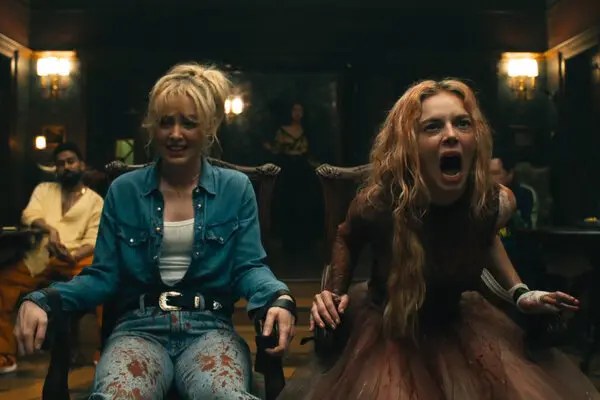
What takes shape afterwards (in the Emily-centered third chapter) is something manifested and formed from the trauma of these events. On paper, what it is should work, and nearly does given what is built up to it, but ultimately deflates the entire film. It’s a noble swing, but in a film based in so much tragedy (real life and fictional), it ultimately becomes bafflingly silly. The wrong visual concept for a film whose tone had up until that point been so effective at unnervingly getting under your skin. With its big showcase entity deployed, much of the character work goes out the window, leaving Tran a role whose only defining quality is her grief, often vocalizing her pain through overt and lazy dialogue and constantly react with large, horrified expressions. It’s not Tran’s fault whatsoever, as throughout, you can imagine her doing wonders with a character with even an ounce more of layers to this role.
As it depressingly limps to its climax, it becomes more clear that its larger thematic scope just isn’t delivering the punch it needs to in its discussion of grappling with buried history. The threads the film spends its first half developing wither away in favor of grotesque imagery that diminishes in impact the longer shown onscreen and an all-too soft landing pad for its main characters. It’s a highly respectful acknowledgement of history, but sadly a dull exercise in paranormal horror.




 jakobtalksfilm.com
Leave a reply to The Minnesota Movie Digest: Issue No. 176 – Minnesota Film Critics Association Cancel reply