
Attempting a biopic on legendary, but controversial pop icon Michael Jackson was never going to please everyone. Depictions of the notorious but once-universally-beloved singer in media within the last thirty years usually default to the same parody of an effeminate, extra-terrestrial-like enigma whether in 2D-construction paper form on South Park to literally being depicted as an alien (and often a predator) in Scary Movie sequels. Jackson even cameoed as himself as an alien in Men in Black II, as well as formed a huge connection to a famous alien icon, E.T., recording an audio-storybook along with a song titled “Someone in the Dark” for and inspired by the Steven Spielberg film. Jackson, even beyond his many controversies, was an alien amongst the global population. A beguiling being that drew eyes, gasps, and screams everywhere he walked. A one-in-a-million talent that defied gravity, yet also one that no amount of personal research could ever really, truly understand. Michael, the first theatrical biopic of one of the most famous people to ever live, promises to do that… or at least, once promised to.
Michael is purely a tribute to the man, honoring his life and rise to stardom despite extreme hardship and abuse. Rather than ever acknowledging the person he inevitably became, the film back-peddles to wipe his slate clean, hoping to preserve the good that Jackson put out in the world above anything, whether it was through his music, his charitable actions, or just his general every-day kindness. What gets lost in this decades-spanning (but unfinished) rise of the superstar is any sense of who he was outside of his career. Michael often makes the point that despite the age gaps between siblings or their silent allowing of abuse by his father, he was incredibly close with his famous family. With most of them sharing producer credits (multiple cards in the end credits stack Executive Producer [insert Jackson family member here]), you would imagine that beyond a squeaky-clean scrub of his life, that you would at least get a window into the Michael Jackson we didn’t know. However, the film instead just plays out like a copy-paste of the Career and Discography tabs of Jackson’s extensive Wikipedia page. It never feels confident that Michael’s family really knew him at all. They knew how he (moon)walked and talked, but anything inside Michael’s head feels purposefully surface-level.
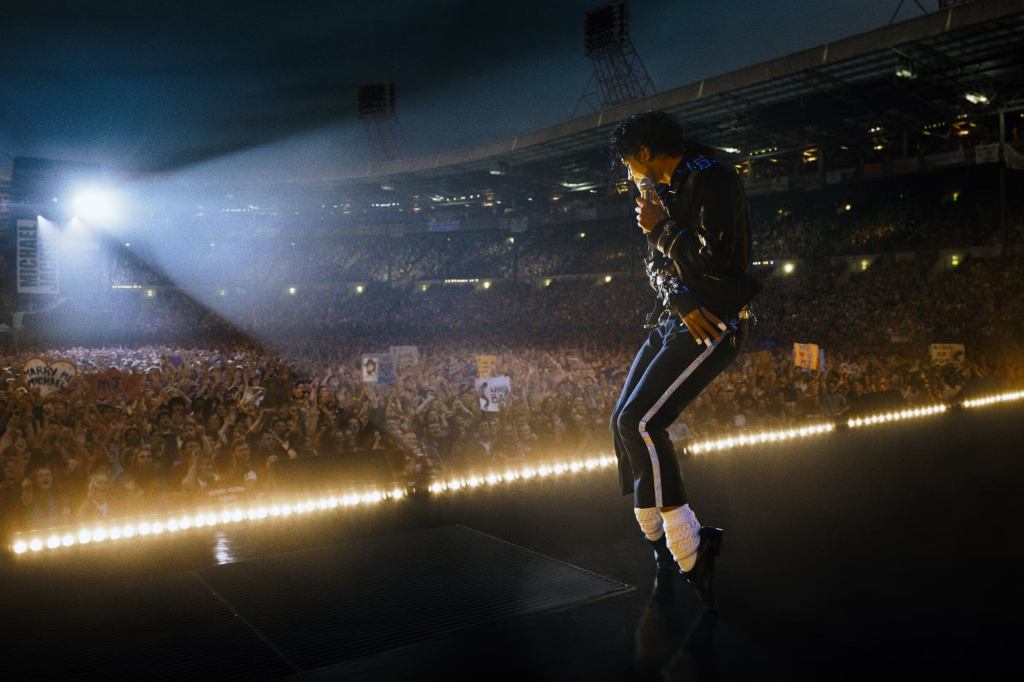
It is no secret that the final third act of this film had to be entirely reworked for legal reasons, trimming a darker opening and Jackson’s court troubles in the early 1990’s out of the narrative entirely. It is also heavily gossiped that director Antoine Fuqua’s control over the film got passed over to Bohemian Rhapsody producer Graham King to work his same sanitized magic. It’s undeniable that King’s influence on Rhapsody was carried over to Michael, a film that was required to at least get the bullet points of Freddie Mercury’s life (whether or not they were accurate) as long as the music was front-and-center. As with Queen, Michael Jackson’s catalog of hits are some of the greatest ever recorded, capable of turning any quiet crowd into a fanaticized frenzy of head-bangers and hand-wavers. This is primarily a concert film, with most of its 130-minute runtime dedicated to perfectly recreating Jackson’s concerts, music videos, public appearances, and cranking up the theatre volume for pure audience escapism. A guaranteed good time if you’re a super fan, although there is nothing here that you wouldn’t already know. Thankfully, despite the lack of a stronger narrative conclusion and the distraction of all the pageantry and spectacle, the film at least uses the arc of the relationship between Michael and his father Joseph Jackson as its foundation, even if it becomes less prominent as the film goes on.
Joseph, or Joe Jackson, was a historic bad dad. Colman Domingo, expert casting of an always-locked-in actor with a growly voice and looming presence, makes a meal out of the role despite the distracting makeup job. Yes, Joe Jackson did look quite a bit like he is depicted in his film in real life, but there is a waxiness to the prosthetics and a bizarreness to the colored eye contacts on Domingo that add to a falseness of reality most of the time he’s onscreen, fully reliant on Domingo to power-act his way through it. His pathetic desperation to maintain control of his son’s career from childhood to his adult solo career is appropriately and justifiably unsympathetic. Nia Long, while deeply underused, plays his mother Katherine, full of quiet warmth and empathy: Joe’s total opposite. In regards to the rest of the Jackson family, they are merely wordless background extras (Janet not even included due to her real-life refusal of involvement). While it is arguably noble to step aside and let Michael’s biopic be about Michael, the lack of characterization with his siblings eliminates any understanding of the bond Michael claimed to have had. We spend a pretty engaging and admittedly-riveting opening half hour depicting the career of the Jackson 5, but rare that the movie ever deciphers who is who, and rarely even utters the names of Jermaine, Tito, Jackie, or Marlon. The best we get is a scene where a disappointed adult Michael, affected with a delayed childhood, brings home Twister to play with his brothers who couldn’t care less about board games.
In terms of Jackson’s career, it is played like a highlight reel that follows the timeline of his music like a checklist. Michael’s insistence on breaking away from his father’s control leads to a split agreement where he can pursue solo work as long as he remains dedicated to the Jackson family contract. Here is where we hit “significant moment” after “significant moment” from inviting members of the Bloods and Crips to be extras on his “Bad” music video, to his adopting of Bubbles (portrayed with obvious CGI), to breaking the racist barriers of being the first black artist to be featured on MTV, which would magnify the popularity of the network altogether. Michael’s manager John Branca is portrayed by Miles Teller, who in an awful wig and an awkward presence, could not seem more bored with the role he’s saddled with but perhaps just happy to be included in the film in general.
It is easy to forget in discussing the film that Michael is played by someone because his nephew Jaafar Jackson’s performance is so calibrated to exacting his persona, it’s as though Michael has been, in spirit, resurrected to relive his life’s events. His look and mannerisms are spot-on, and at times freakishly-uncanny. It’s the type of casting that could only happen once in a lifetime and easily allow a large audience to instantly accept someone who isn’t Michael play Michael. To say he gets much to chew on beyond embodying the characteristics of his uncle is a stretch as the film forgoes so much of Michael’s complicated personality, it never feels like Jafaar is allowed to exert anything other than pure innocence and blank positivity.
Who is just as, if not even more impressive, is Juliano Valdi as young Michael, who carries the film on his shoulders for the first quarter mesmerizingly and nearly steals the show from the entire cast. Valdi portrays the singer during the most violent period of his life with stunning maturity yet is also able to light up the room as Michael once did with mesmerizing electricity. A child performance that is guaranteed to be a huge launching point for the young actor. There is a sense of sadness once the film hard-cuts to the adult Michael as the story of the Jackson 5, while filled with trauma, is the most emotionally engaging element of Jackson’s story, as though we’re leaving a better film in favor of a 90 minute block of music videos.
Yes, it leaves most general audiences on a high note, but to bookend Jackson’s story with the darkness of his childhood leading to the darkness of his adulthood would have emphasized the truthfully unfortunate cycle he dealt with, the cautionary consequences of an abusive parent that left lasting impact on the mental health of his child. Leaving the film on a fireworks show of glitz and glamor can’t help but feel false because the back half of his life is too publicly known. The film promises there is more story to tell, so maybe a Part Two could relieve that criticism an two halves can complete the whole spectrum of Michael, but no matter how much money this film is destined to make, there just isn’t a conceivable world where his family, nor Lionsgate, ever intend to portray the events of Michael Jackson after 1988, even in 100% defense of its subject. Likely, everyone involved will play it safe, take the check on this film alone, capitalize off the box office gross and the inevitable streaming boom of his music sales, and call it a day. People that know they will enjoy this, will do so. Inevitable to be played in the future at home as background noise during laundry folding or as a Best Buy test for their newest speaker system. A totally breezy escape that plays just effectively with your eyes closed, like an album with speaking interludes.




Leave a Reply