
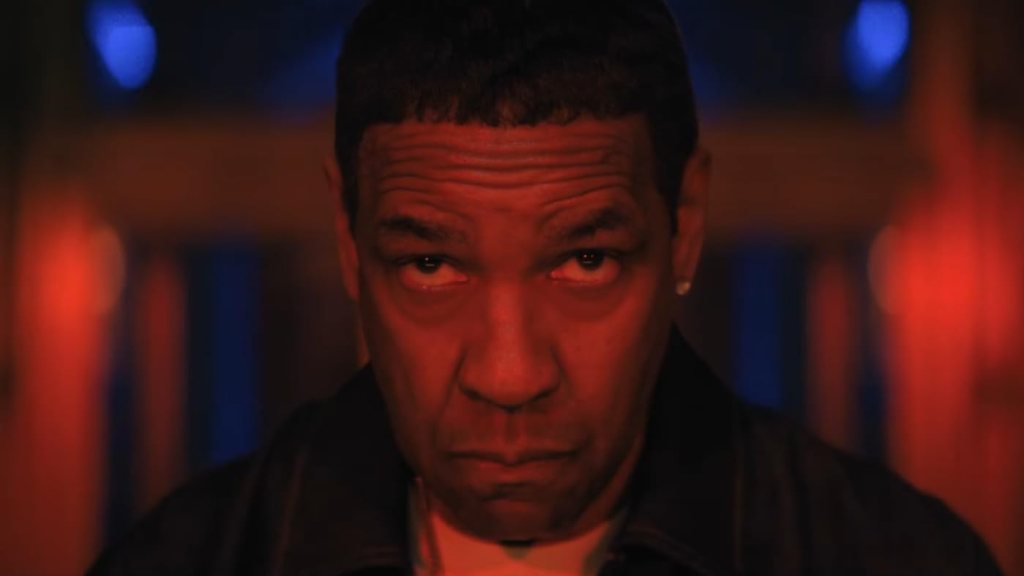
Akira Kurosawa was arguably the greatest living filmmaker of his time and High and Low (1963), based on the 1959 novel King’s Ransom, is often regarded as one of his best films. Spike Lee, also one of the greatest and most influential filmmakers of his generation, had already infamously remade a beloved film back in 2013 with Oldboy, leading many to question if Lee’s gifts were just better suited away from remakes altogether. Regardless of what behind-the-scenes mess led to the final product of Oldboy, Lee and pal Denzel Washington gave themselves the task of putting a modern spin on High and Low, this time with much more creative freedom through A24 and Apple. The results, while occasionally wobbly, are wildly impressive, though even through its bumpier moments, remains effortlessly watchable do to the magnetism of Denzel Washington.
While the core story and narrative structure of High and Low remain mostly intact, Lee and screenwriter Alan Fox’s adaptation switches the 1960s Japanese Shoe Company setting to the competitive and modern world of the New York music industry. Washington, in the Kingo Gondo role, plays David King, a music mogul hoping to buy majority ownership of the business he built, Stackin’ Hits Records. One day, he gets a phone call from an anonymous voice claiming to have kidnapped his son Trey (Aubrey Joseph) only to discover that Trey was mistaken for Kyle, the son of King’s driver and best friend Paul Christopher (Jeffrey Wright). Gambling with the money he intended on buying out his company with, King must do the right thing and cooperate with the ransom.
It becomes immediately understandable why High and Low, a seemingly untouchable movie, could be reinterpreted for a contemporary audience, through a culture switch and under the direction of a completely different visual eye: the story is just so concrete. How the screenplay adjusts the roles to work with this cast, in this setting, totally cracks the code on how anyone should remake a classic film. Perhaps Kurosawa’s storytelling felt forward-thinking enough, always pushing the boundaries of film in innovative ways anyway. Lee uses High and Low as his blueprint but doesn’t lean on it through to the end. In fact, the weakest chunk of the film is the first act, where it is the most faithful to the original, mostly due to both a measured pace and an intrusive musical score by Howard Drossin. But everything improves dramatically once King’s plan to retrieve Christopher’s son and exchange the ransom money goes into motion.
The middle act of this film is some of the best work of Spike Lee’s career. A vibrant, chaotic, thrillingly-plotted and expertly blocked action sequence that has you on the edge of your seat. Washington, at 70, remains an ageless action star and commands the screen with such ferocity. Washington’s untethered acting choices and booming voice alongside Jeffrey Wright’s perfectly subtle-under-pressure performance is the perfect onscreen pairing. The score also dramatically improves, its kinetic strings and piano far better paired to its deftly paced on-foot chase sequences, and exhilarating moments of tension.
Transitioning into the final act, Lee gets experimental. Our captor, Yung Felon (ASAP Rocky) is introduced in the flesh in full and in surprising but invigorating moments, the power of music is placed at the forefront. The script finds a brilliant spin on the “protagonist of higher class talking through a glass wall to his antagonist of lower class” scene. While Lee is making thrilling choices behind the camera, this is also where the film’s faults start to finally become clear. The original’s take on class disparity made both the final scene a gut-punch and the film as a whole a potent watch. There isn’t much emphasized about class whatsoever. Yung Felon isn’t sympathetic or nuanced. ASAP Rocky’s performance is relatively flat, and not just in comparison to Washington. The air leaks from the balloon in the last stretch, which is unfortunate, because given its more modern setting, it always feels like Lee could find something new to say about the state of the current world and he only really brushes past it.
That said, despite a slightly overlong runtime, he’s still somehow made a terrifically entertaining piece of work, and only aided by one of the greatest actors alive consistently elevating every second of the screen. Lee and Washington have only made five films together including this one and yet it feels like they’ve made a hundred. One of those pairings that feels like it should go on until the end of time.





 jakobtalksfilm.com
Leave a comment