
While the true synopsis of “Eleanor the Great” has been kept vague in its marketing, for review purposes, plot details will be discussed.
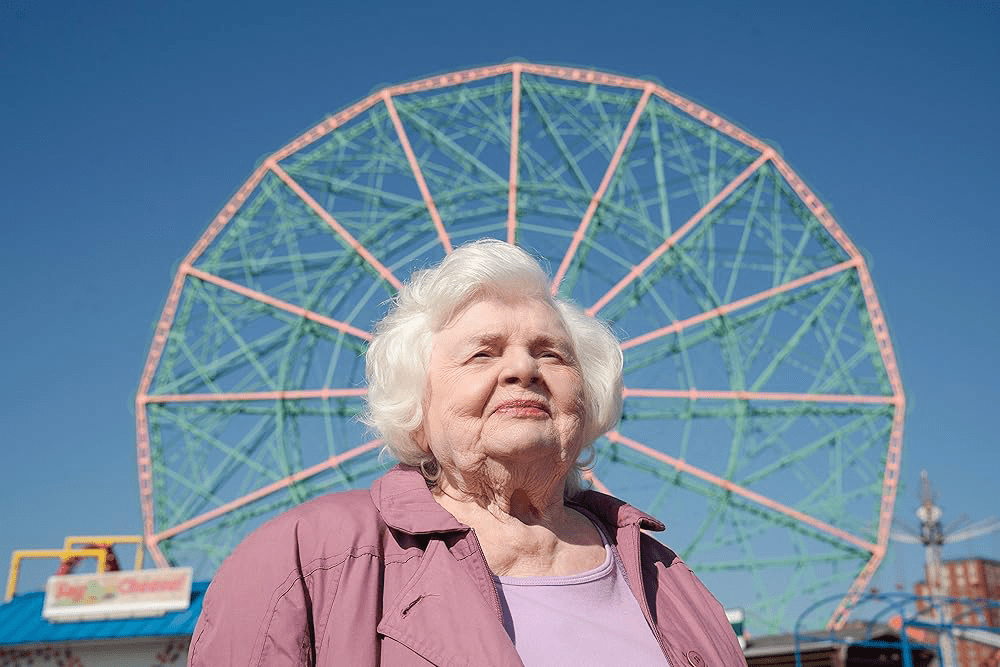
Few actors working today have gotten to have a late breakthrough finally pay-off the way it has for June Squibb. At 83, and after decades of bite-sized parts in prestige films, Squibb nabbed a career-catapult with Alexander Payne’s Nebraska (2013) and has since become the go-to for sweet but feisty women of a certain age, recently celebrated last year for her role as a scammed grandmother seeking vengeance in Josh Margolin’s Thelma (2024). Squibb, now 95 and with no plans to slow down, has now coveted the lead in Scarlet Johansson’s directorial debut Eleanor the Great, a dramedy about an elderly woman who strikes up a friendship with a young student after attending a Holocaust survivor support group. Squibb is perfectly cast, being both the appropriate age and personality, a decades-long giyoret, and an actress who has been deserving of a large, meaty role her entire career. The material is a great fit for Johansson’s directorial debut: she herself is a New Yorker (this is a very New York movie) and being of Jewish ancestry. You can see immediately why there was so much care in telling an honorable Jewish story onscreen. But somehow, Johansson’s treacly directorial tone and Tory Kamen’s overbearing script completely fumble what is clearly the most committed and emotionally heavy role Squibb has ever given.
It starts lovely. Johansson’s delicate approach allows great affection to the introduction of Eleanor Morgenstein and her close friendship with Bessie (Rita Zohar), both of which have been in each other’s lives for seven decades. Past kids and dead husbands, they are now roommates in a Florida apartment, even sleeping beside each other in twin beds. Bessie, a Holocaust survivor, occasionally waking up to nightmares of her past, and having shared countless stories to Eleanor in great detail, one day collapses in while grocery shopping and soon after, passes away in her hospital bed. Dealt with unimaginable grief buried under a wise-cracking attitude, Eleanor moves in with her daughter Lisa (Jessica Hecht) and grandson Max (Will Price). Lisa, in an attempt to keep her mother social, sends her off to a singing class at their local Jewish Community Center. Only, Eleanor is guided into the wrong room: a Holocaust survivor support group. There, attending for research purposes, is college student Nina (Erin Kellyman), who takes great investment into Eleanor’s harrowing stories of her childhood. What she and the others don’t realize is that Eleanor only just shared a white lie, one inspired by Bessie’s true stories, and from then on is mistaken for being a survivor herself. Realizing her lie has helped her blossom a new friendship, as well as gaining heaps of admiration from everyone around her, she keeps it going.
Now, this is the perfect premise for a dark comedy and a risky one at that had it decided to be that, but the script clearly never had that intention. Despite a few cheeky insults by Eleanor, this is a full-blown weepy, one filled with lectures, heavily detailed discussions of the Holocaust, and characters explosively explaining their grief. While topically heavy, and going out of its way to be respectful, it’s a film that struggles to let the audience breath as it beats you down with interminable sadness. Characters often go to cry alone in rooms, and not just tear up, but guttural sob. Dustin O’Halloran’s score is overwrought from the start, hitting every high-pitch piano key hoping to squeeze every last tear drop out of your eye, even when the scene isn’t asking for it. There is almost no levity to the film when it desperately needs it. The most charming supporting performance comes from Chiwetel Ejiofor as Nina’s news anchor father, though Ejiofor was far better used in two other movies this year dealing with grief, The Life of Chuck and Bridget Jones: Mad About the Boy.
Kellyman is a talented actress and has immediate chemistry with Squibb. Scenes with her and Squibb together, spending time out in the city getting to know one another, showcase the best of Johansson’s directorial abilities. Conversations are quiet but soothing, the focus completely on her actors getting acquainted with one another naturally. Some of Johansson’s best performances as an actress are in softer, tender films such as Her and Lost in Translation and she is able to bring that same sensitivity and human connectivity to the screen between two great performers. However, when the script calls for a brash joke, it often lands with a thud because the tone isn’t matched.
At the center of it, keeping most of the audience engagement going, is Squibb who digs extraordinarily deep into the character of Eleanor. She is radiant, even despite tackling such a challenging character. Her smile lights up a room. Eleanor’s pain is expressed beautifully through Squibb’s emotive eyes and endearing voice. Her performance is worth the price of admission, but the film around her can’t help but feel manipulative, bogged down with the insistent intentions of just making the audience cry without truly earning it. Like expecting a warm hug and instead getting beaten with a sack full of bricks.






 jakobtalksfilm.com
Leave a comment