
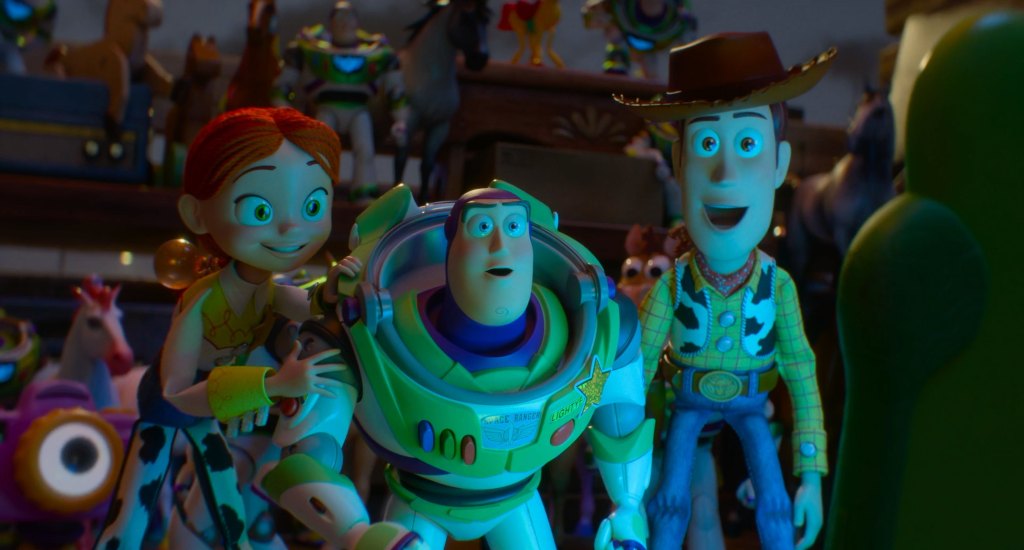
Whether concluding with “So long, partner…” or to “infinity and beyond”, the last few Toy Story films have always closed on a note that feels like a book being folded shut, one last hurrah as you wipe the tears from your eyes. Toy Story 3 (2010) had been in development for so long, it seems like it would never happen. The fourth film’s announcement years later, felt like a betrayal until the film’s release, where its gut-busting laughs, surprisingly complex message, and hit-like-bricks ending proved otherwise. Along with a toy chest’s worth of enjoyable shorts and TV specials, it seems like the Toy Story franchise is here to stay and prosper, but only as long as there is a story worth telling. While Toy Story 4 (2019) was a far more introspective journey for its lead character Woody (Tom Hanks) and his true purpose in the world, Toy Story 5 not only now shifts the narrative to his cowgirl deputy Jessie (Joan Cusack, now the “Sheriff” of the toy community), but steps back to lasso in a far more relatable and modern issue: children’s real-life co-dependency with technology and how it affects their social skills.
Yes, the toys’ existentialism of children growing older and no longer needing their toys is now occurring at a faster rate with the introduction of the internet being universal in all things. Younger and younger are children who feel like they need to move on to devices that deliver information with the tap of a finger over their own imagination guiding their creativity and driving their happiness. With all of that looming over them all like a dark cloud, Buzz (Tim Allen) and the gang must find a way to prevent their child owner Bonnie’s new activity device Lilypad (Greta Lee) from consuming her everyday life. Bonnie (Scarlett Spears), struggling socially due to her own insecurities and also the vapidness of her peers around her, begins to rely on Lilypad as her way of distraction and as a false sense of communicating and bonding with her dance recital classmates. Misinterpreting a walkie-talkie call from a distressed Jessie, Woody, who has been helping rescue more abandoned toys by the day alongside his love Bo Peep (Annie Potts), returns to help the gang. Jessie, taking matters into her own hands, stows away with her trusty steed Bullseye on a mission to monitor Bonnie attending an unsuccessful sleepover, and ends up getting separated, winding up back in an all-too familiar home she once knew long ago.
Already, the Toy Story franchise has now so many characters in its ensemble that not only is their a slight overabundance of storylines, but many beloved characters including Rex (Wallace Shawn), Slinky (Blake Clark), and Mr. Potato Head (Jeff Bergman, taking over for the late Don Rickles) barely get more than a few lines this time around. New additions this time around include an absolutely hysterical potty training device named Smarty Pants ( a brilliant Conan O’Brien), a GPS hippo toy named Atlas (Craig Robinson), and a toy camera named Snappy (Shelby Rabara) introduced to Jessie while on her solo mission. Also returning from the previous film is the comic standout Forky (Tony Hale), who now has a knife-wife in Karen Beverly (Melissa Villasenor). But that’s not all! There are also a group of fifty Buzz Lightyears (all voiced by Tim Allen) that have washed up on an island after a failed delivery, stuck in demo mode and searching for their supreme leader. Toy Story 5 has a lot going on on top of depicting a very urgent message about the over-reliance on technology. Yet, somehow, like magic (or like a Toy Story movie usually does), everything seems to mesh together perfectly by the end, wrapping up its dissertations and wringing out genuine emotional honesty out of its ever-endearing characters.
Cusack gets the bulk of the material, and for an actress who had stepped away from the business for the last half a decade, her vocal work here is nothing short of tremendous. With her original introduction, Jessie’s arc in Toy Story 2 (1999) was a gobsmack revelation, peeling back her emotionally-closed off, high-energy persona to reveal a lonely soul afraid to be cared for again. Now fully integrated with her strong bonded community of toys and renewed love from Bonnie, Jessie’s sudden confrontation with her past leads to down some fairly complex avenues, torn between her own place in the world, where she was always meant to be, and returning to a child who may have already moved on from her. Cusack takes impressive command over the likes of Hanks and Allen (though Allen’s requirement in voicing fifty Buzz Lightyears is an enjoyable treat in of itself) and still is able to tap into that raw vulnerability that gives Toy Story 5 a good chunk of its emotional heft. Emotional instrumental cues also are reintroduced by composer Randy Newman, who ditches the original film’s delightful and nostalgic anthem “You’ve Got a Friend in Me” for reviving the notes of the Sarah McLachlan-sung, heart-pummeling “When She Loved Me”. Classic PIXAR veteran Andrew Stanton helms the sequel this time around, guiding the franchise towards the most natural and sensible direction while still managing to impress on a visual level. The film’s “virtual cinematography” moves throughout the animated scenery in noticeable ways that keep the blocking and direction feeling fresh and new. While weighty in its relevant themes, the film is still a total laugh riot and consistently features some truly delightful comic surprises, including an army of toy horses and visual gags teasing Woody’s “aging”.
Those who are expecting this film to be a total damning of AI, apps, and high-tech should pump their breaks a bit, though the film’s views on these devices in children’s lives is nonetheless extremely and justifiably critical. We see how Lilypad affects and changes Bonnie’s social and emotional psyche and daily habits just as one such “toy” does nearly every other kid, older and younger, that exist in our current time. Message-wise, it feels as targeted to kids who don’t know any better as much as it is their parents who may have succumbed to the tempting ease of a quiet child. Once again, the Toy Story films, personifying plastic playthings as sentient beings with souls, have found a new way of initiating a wave of appreciating imagination to its worldwide audience, and in our AI-dominant world led by morally-heinous capitalist leeches (apologies in getting politically carried away, as this is just a review for a Toy Story film), it’s up to parents and children alike to remember that having imagination is the most authentic human trait we have. When Toy Story 3 ended, it seemed too sacred a toy box to reopen, yet as the fourth and now fifth film prove, as we head toward the grim abyss of a tech-forward future, a new Toy Story every generation or so now seems universally demanded. A revolving reminder to care for, connect with, and appreciate the carefree bliss of childhood for as long as we can. Toys may live forever, but childhood innocence is blink-and-you-miss-it.






 jakobtalksfilm.com
Leave a comment